













Month to month. Cancel any month. See pricing

Get a PR diagnosisGet a 15-minute PR diagnosis

Share of voice in PR

Share of voice is the part of a conversation that belongs to you.

In PR it usually means your share of media mentions against a fixed group of competitors over a fixed period.

Muck Rack defines it as the number of earned media mentions your brand received in a period compared with competitors.

A board understands it at first sight, which is why it is easy to fake by accident.

Analyst sorting printed media mentions into one pile per brand to compare share of voice

Illustration

How many PR teams track it

  • 37%of PR pros reported using share of voice to measure results, per Muck Rack's State of PR Measurement, 2023muckrack.com
  • 56%measure audience reach, the most used PR metric in the same 2023 surveymuckrack.com

What is share of voice

The term comes from advertising, where it meant one brand's part of category ad spend.

PR borrowed it for earned attention and counts stories and citations instead of dollars.

It shows how often people reading about your category read about you, not whether they liked it or bought, so pair it with other measures.

Share of voice, one brand slice of all the coverage

Copy and send

Share of voice formula

Your count for a period, divided by the combined count for you and every tracked competitor, times 100.

Share of voice formula

Your count. Stories naming you in the period, or AI answers naming you, never both at once.
Whole set. The same count for you plus every competitor on the fixed list.
Result. Your count divided by the count for the whole set, times 100.

Almost every error comes from the inputs, meaning which competitors are in the set and what counts as one mention.

How to calculate share of voice step by step

Six steps, and the first three are fixed before counting starts. Unexplained swings usually trace back to a changed input.

  1. Fix the competitor list

    3 to 6 rivals, unchanged for the quarter.

  2. Fix the unit

    Bylined stories or AI answers, say. One unit per calculation.

  3. Fix the period and market

    One month and one country or language. Never blend markets into one global figure, because a local rival in Poland may be unknown in the UK.

  4. Collect and clean

    Remove reprints and your own posts, then read what is left for false matches.

  5. Count and divide

    The shares add up to 100% within your set.

  6. Write down the method

    Next month someone will ask why the number moved.

A month of trade press, counted

An illustrative month in trade press for four fictional energy storage companies, counting bylined stories only, reprints removed.

BrandBylined storiesShare of voice
Gridwise930%
Rival A1240%
Rival B620%
Rival C310%
All four brands30100%

Count reprints and the picture flips. One Rival B story copied to 40 aggregators would put Rival B in the lead with no extra reporting, the most common way share of voice lies.

A balance scale with one large circle against many small ones
One big outlet weighed against many small ones.

Should big outlets count for more

A plain count treats a local blog and a national daily the same, and weighting fixes that with more assumptions.

For most small companies a plain count of bylined stories plus a fixed list of priority outlets is the honest choice.

  • Plain. Every story counts as one.
  • Reach-weighted. Multiplied by an estimate of outlet traffic, not readers of that story.
  • Sentiment-weighted. Negative stories counted apart, though automatic sentiment misreads bad-news coverage.
  • Tier-weighted. Priority outlets count more, from a list fixed in advance.

Types of share of voice

The same formula runs on different units, and a brand can lead one and trail another.

Track the first three together for a PR program.

TypeWhat it countsWhat it tells you
News share of voicebylined press storiesthe classic PR measure
Link share of voicenew sites linking to each brandwho earns reviews and list mentions
AI share of voiceAI answers that name each brandwho buyers hear about from assistants
Social share of voiceposts and commentsnoisy, closer to marketing
Paid share of voicead spend or impressionsthe original advertising meaning

How to measure AI share of voice

AI share of voice needs a fixed set of questions instead of a fixed set of outlets.

The audit behind it is on AI search visibility.

  1. Draft ten prompts in your customer's words

    Best provider, cost, alternatives.

  2. Ask every engine on the same weekday

    Three engines, ChatGPT among them, give 30 answers a week.

  3. Score each answer

    Named or not, position in the list, pages cited.

  4. Divide

    Answers naming you over answers naming any brand in your set, times 100.

  5. Follow the citations

    Pitch or correct the pages that win answers for rivals.

Why small samples mislead

Small counts swing hard. Three stories last month and five this month can move your share 20 points with no real change.

AI answers are noisier. Our 48 logged answers in September 2026 cited 255 sources on 177 sites, 130 of them once.

Report a rolling four-week figure and show raw counts beside the percentage.

Small counts swing, larger samples hold steady

Copy and send

Share of voice calculator in a spreadsheet

A shared sheet is enough for the first quarter.

One tab per unit keeps numbers apart, and the AI tab counts answers naming a brand, not repeat mentions.

The notes column makes the chart readable three months later.

Share of voice sheet

News tab, one row per story
Date | Brand | Outlet | Author | Link | Original reporting yes or no

AI tab, one row per answer
Date | Engine | Question | Brands named in order | Pages cited

Notes column on both tabs
Anything that explains a jump, such as a funding round or a conference week

Share of voice vs market share

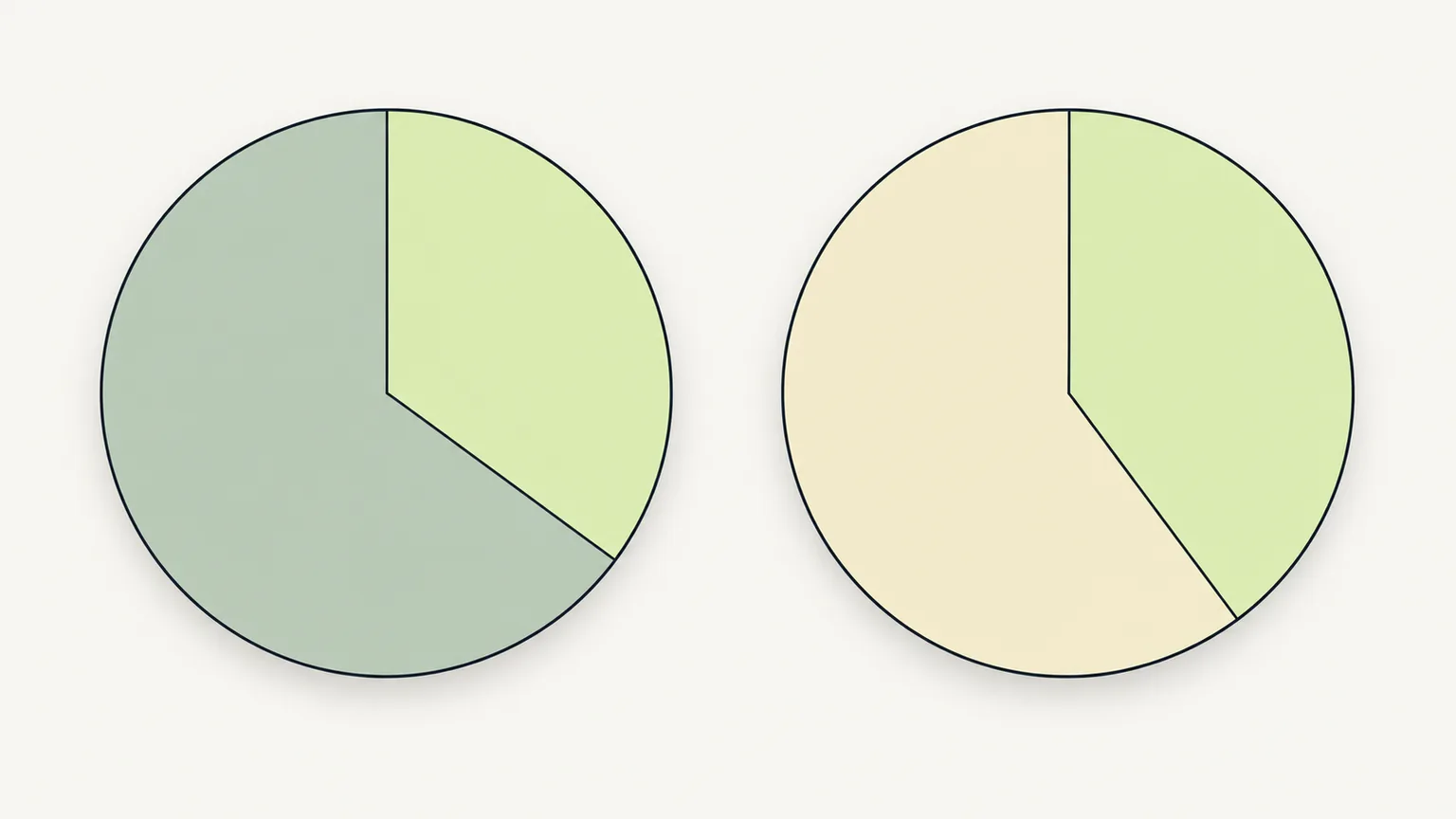
The two are related but not the same. Market share is your part of sales. Share of voice is your part of attention.

When share of voice runsWhat advertisers often expect
ahead of market sharethe brand grows
behind market sharethe brand loses ground over time

For a startup it is a sanity check. A tenth of the market with a third of trade coverage means PR is punching above its weight.

Two pie shapes side by side with different pistachio slices
Share of voice set next to market share.

Mistakes that inflate share of voice

  • Counting reprints and syndicated copies as separate stories.
  • Changing the competitor list between reports.
  • Mixing units, such as adding AI answers to press stories in one number.
  • Reporting a weekly swing without the raw counts behind it.
  • Treating a high share of voice as proof of good coverage when much of it is negative.

The monthly count we keep for you

  1. The competitor set, agreed once

    We fix the list of rivals and the spelling rules for each before counting, so the number means the same thing every week.

  2. Three counts, one table

    Each month your share of news stories sits next to your share of AI answers and of new linking sites, always against the same rivals.

  3. A four-week line, not a daily score

    We report the rolling trend and say when a change is too small to trust, instead of celebrating one lucky week.

Winning the news count, losing the AI count

Winning the news count and losing the AI count

Situation
A fictional B2B software firm held the largest share of trade press stories in its niche for a quarter.
What we do
Its first AI share of voice count ran ten buyer questions on three engines and found it named in four answers out of thirty, while a smaller rival was named in eleven.
Outcome
The rival's lead came from two comparison articles the assistants kept citing, so the firm pitched the authors of those articles with fresh data.

Illustrative example, not a client result

Anastasiia Bratkova portrait

Anastasiia Bratkova

Chief Brand, Marketing & Communications Officer, RSE

Signs every pitch

About Anastasiia

Questions

What people ask when the number moves

What is a good share of voice?

There is no universal number. A useful target is a rising four-week trend against a fixed set of rivals, and a share at least equal to your share of the market.

How do you calculate share of voice?

Count your mentions in a period. Count the mentions of you and every tracked rival over the same period. Divide the first number by the second and multiply by 100.

Is share of voice the same as market share?

No. Market share is your part of sales. Share of voice is your part of attention. Advertisers first used it for ad spend, and PR uses it for earned coverage.

Can I calculate share of voice for free?

Yes for small sets. Google News search plus a spreadsheet will do if someone gives it an hour a week. That holds for 3 to 5 rivals in one market.

What is AI share of voice?

It is the share of AI assistant answers to your buyers' questions that name your brand, compared with the answers that name your rivals.

Sources

Next step

Get the template

A senior PR expert sends it within one business day, with a story angle for your company.

Write in Telegram